
Patch Test First: Remove Glass Pool Tile Scale Safely for Pool Owners
Start with a patch test on a 2- to 3-inch section, then treat it with diluted white vinegar or a citric acid solution for 5 to 10 minutes and wipe. If the chalky film lifts, repeat the mild cycle across the rest of the tile line and rinse well. If a hard crust remains after several gentle rounds, move up to a pool-safe descaler or wet pumice, and call a professional for thick, old buildup or delicate glass tile. Always rebalance your water chemistry afterward or the scale comes right back.
TL;DR:
- Light calcium scale on glass tile responds well to a patch test with vinegar or citric acid, but dense or old buildup often requires a professional media blast.
- Use a 1:1 vinegar solution or citric acid for 5 to 15 minutes and rinse thoroughly, repeating cycles for moderate deposits before considering stronger treatments.
- Avoid abrasive pads, strong acids, or aggressive scrubbing on glass tile to prevent permanent surface damage, especially if etching is already present.
- Maintain water chemistry with pH between 7.4 and 7.6, alkalinity between 80 and 120 ppm, and calcium hardness around 200 to 400 ppm to slow scale reformation.
- Reserve muriatic acid or commercial descalers for only dense, stubborn scale and consider professional help if scale has hardened over multiple seasons or is on expensive glass surfaces.
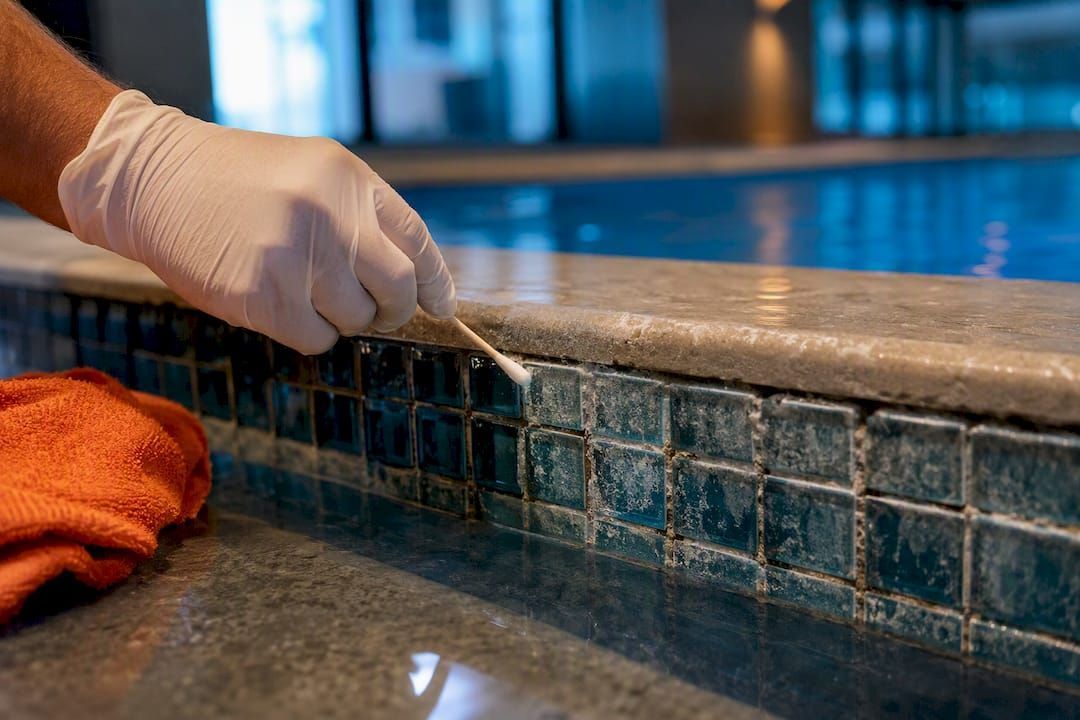
Table of Contents
- Is That White Film Calcium Scale, Etching, or Something Else?
- What Are the Best Methods to Remove Scale from Glass Tile?
- What Tools and Safety Gear Do You Need Before You Start?
- How Do You Stop Glass Tile Scale from Coming Back?
- Oceancare Store's Approach to Safer Scale Removal
- When Should You Just Call a Pool Professional?
- Does Water Hardness Actually Change How Fast Scale Forms?
- Can Scale Buildup Permanently Damage Glass Tile?
- How Do Commercial Descaling Products Actually Compare on Glass Tile?
- Why Patience Beats Aggression on Glass Tile
- Keep Your Glass Tile Clear with the Right Product for Each Stage
- Sources
- FAQ
Is That White Film Calcium Scale, Etching, or Something Else?
Not every hazy patch on your glass tile is scale, and treating etched glass like it's scale will make things worse instead of better. The distinction matters because scale is a deposit sitting on top of the glass, while etching is permanent damage to the surface itself.
Calcium scale usually looks chalky, flaky, or crusty, often gray or white, and it tends to build up right at the waterline, around spa spillways, and near aeration jets where evaporation concentrates minerals. Etching, by contrast, shows up as a smooth, dull haze baked into the glass. No amount of cleaning restores shine to etched glass because the damage sits below the surface, not on it.
The quickest way to tell them apart:
- Wipe test: Rub the area with a wet microfiber cloth. Scale often smudges or loosens slightly; etching stays exactly the same.
- Scratch test with a fingernail: Flaky scale sometimes chips at the edges. Etching feels perfectly smooth, just dull.
- Location pattern: Scale clusters at the waterline and near return jets. Etching tends to spread more evenly across exposed tile.
- Patch test: Apply a mild acid solution to a 2- to 3-inch section for 5 to 15 minutes, then wipe and rinse. A controlled patch test is the most reliable way to confirm whether you're dealing with removable deposits or permanent surface damage before you commit to treating the whole wall.
If the patch test area looks brighter and feels clean, you're dealing with scale. If it looks the same, or worse, stop. Further chemical or mechanical treatment on etched glass just wastes product and risks damaging the grout around it.
What Are the Best Methods to Remove Scale from Glass Tile?
Work from the gentlest option to the most aggressive, and don't skip ahead just because a step feels slow. Glass tile is more delicate than porcelain or natural stone, and manufacturers specifically warn against abrasive pads and strong acids that can dull the finish or damage the backing.
- Rinse and wipe first. Plain water and a microfiber cloth remove loose debris and let you see what you're actually dealing with.
- Try a mild soap solution. A few drops of dish soap in warm water handles surface grime that isn't true mineral scale.
- Soak with diluted white vinegar. Mix a 1:1 vinegar-to-water solution, apply it to the affected area, and let it sit for 5 to 10 minutes before wiping with a microfiber cloth and rinsing thoroughly. This handles light deposits well.
- Step up to citric acid for moderate buildup. Dissolve 1 to 2 tablespoons of citric acid in a cup of warm water and apply for 10 to 15 minutes. Citric acid binds calcium into a soluble complex, which helps prevent the minerals from redepositing once you rinse, and it's noticeably less pungent than vinegar if you're doing several rounds.
- Repeat in short cycles rather than one long soak. Two or three 10 minute applications outperform a single hour-long soak and reduce the risk of the acid working on grout or metal trim nearby.
- Move to mechanical methods if chemical soaks stall. A wet, non-scratch sponge or soft-bristle brush can lift loosened scale. Pool-safe pumice can work too, but only when kept wet and used with light pressure, since dry pumice or heavy scrubbing scratches softer glass finishes.
- Try a commercial pool-safe descaler for dense crust. Formulated calcium removers dissolve mineral buildup faster than kitchen acids, but follow the label's dilution and dwell time exactly, and check whether the instructions call for vacuuming residue to waste instead of running it back through your filter.
- Treat muriatic acid as a last resort, not a first move. It strips scale fast, but it's also caustic enough to damage grout, etch glass permanently if left too long, and burn skin or eyes on contact. If you're considering it, dilute per the manufacturer's exact ratio, work in small sections, and honestly, hire a pool professional instead of guessing.
- Call in professional media blasting for old, hardened scale. Pros use glass bead, kieserite, or Maxx Strip media matched to your tile's hardness, since choosing the wrong media hardness can gouge glaze that chemicals alone never would have touched.
Pro Tip: Keep a spray bottle of plain water nearby during any acid step. If you notice the glass dulling or the grout starting to look chalky and soft, flood the area with water immediately rather than waiting to finish the cycle.
What Tools and Safety Gear Do You Need Before You Start?
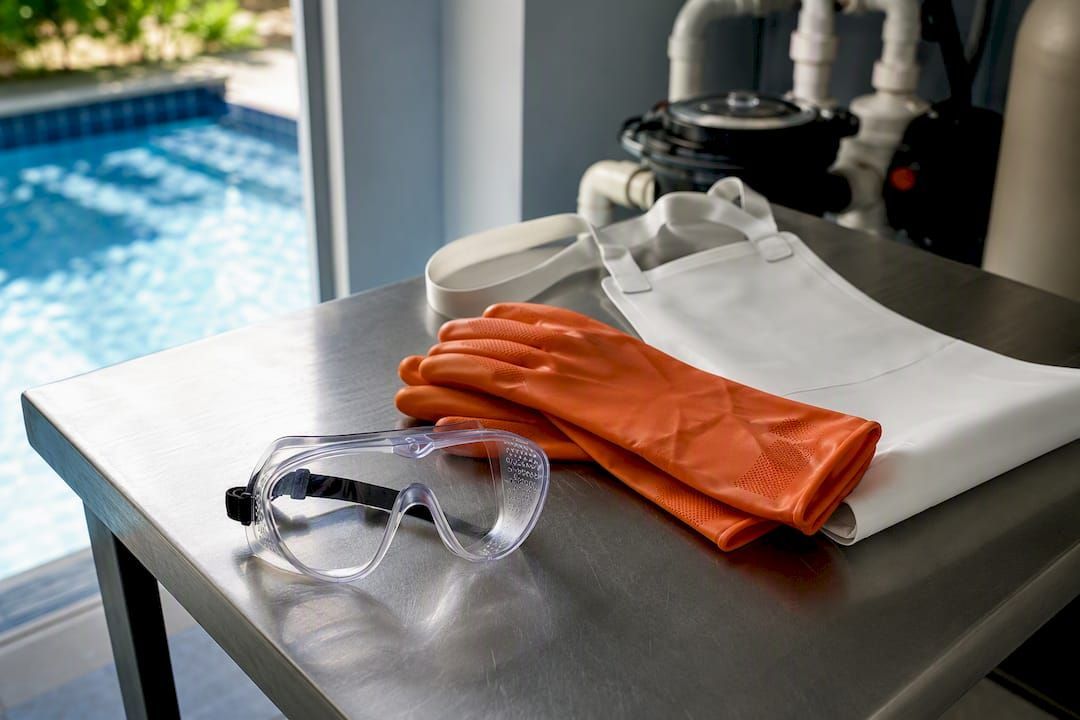
Chemical splashback and fumes are the real risk here, not the scale itself, so gear up before you mix anything.
Wear chemical-resistant gloves and eye protection any time you're working with vinegar concentrations above household strength, citric acid solutions, or commercial descalers. Closed-toe shoes matter too. Acid solutions run downhill fast on wet pool decking. If you're working in an enclosed spa area or indoor pool room, open windows or run a fan. Fumes from vinegar and citric acid are mild, but muriatic acid vapor is genuinely dangerous in a closed space.
Stock these before you begin:
- Microfiber cloths for wiping and buffing
- Soft-bristle brush and a non-scratch sponge
- A labeled spray bottle for your vinegar or citric acid mix
- Plastic sheeting and painter's tape to mask nearby stone, metal ladders, and light fixtures
- Pumice specifically labeled safe for pool tile, not a general-purpose hardware version
Pre-wet porous surfaces like natural stone coping before any acid drips near them. Acid that would barely touch glass can etch or discolor stone almost instantly. Have a clear rinse path planned so runoff doesn't pool against metal fittings, and if you use anything stronger than household vinegar, check whether it needs to be vacuumed to waste rather than sent back through your filter and returned to the pool.
How Do You Stop Glass Tile Scale from Coming Back?
Cleaning scale off without fixing your water chemistry is like mopping up a leak without turning off the faucet. It'll be back within weeks.
The three numbers that matter most are pH, total alkalinity, and calcium hardness. Keep pH between 7.4 and 7.6, total alkalinity between 80 and 120 ppm, and calcium hardness between 200 and 400 ppm for most residential pools. When pH and alkalinity run high alongside elevated calcium hardness, calcium carbonate precipitates out of the water right at the spots where water evaporates fastest, which is exactly why scale forms in a visible line at the waterline and clusters around aerators and spillways.
Build these habits into your routine:
- Brush the waterline weekly, even when it looks clean, since scale often starts as an invisible film
- Reduce unnecessary aeration and waterfall features during peak evaporation months
- Test and adjust fill water before topping off, since hard tap water reintroduces the same minerals you just removed
- Check salt cells and chlorinator components regularly, since scale builds inside equipment as readily as on tile
- Consider a scale inhibitor product if your fill water runs consistently hard, understanding that inhibitors slow new buildup but don't remove what's already there
Pools with calcium hardness consistently above 400 ppm see scale return noticeably faster than pools maintained in the 200 to 400 ppm range, which is the core reason chemistry control outperforms repeat scrubbing as a long-term strategy.
Oceancare Store's Approach to Safer Scale Removal
Some stores lean toward acid-free and low-VOC formulas for a simple reason: harsh acids don't just risk your glass tile, they put grout, metal trim, and anyone nearby breathing fumes at risk too. A pH-neutral cleaner can handle routine maintenance and light mineral film without the guesswork that comes with mixing your own vinegar or citric acid ratios.
The same rules apply regardless of what you're using. Patch-test a small section first, respect the dwell time listed on the product, and rinse thoroughly before letting the area dry. Skipping the rinse step is one of the most common reasons any descaling product, ours included, leaves streaking behind.
A few practical notes if you're building out your cleaning approach:
- Acid-free formulas are the safer starting point for glass tile specifically, since they carry no risk of etching if you leave them on too long
- Low-VOC products matter most in enclosed spa areas or indoor pool rooms where ventilation is limited
- Pairing a calcium remover with a penetrating or enhancing sealer afterward on surrounding stone helps prevent the same minerals from soaking back in
None of this replaces fixing your water chemistry. It just means the cleaning step itself carries less risk to you, your tile, and everything sitting next to it.
When Should You Just Call a Pool Professional?
If the haze remains smooth and dull after a proper mild acid cycle, that's etching, and no amount of scrubbing fixes it yourself. Hard, widespread crust that's built up over multiple seasons, or scale on expensive glass or glass mosaic tile, is also worth handing off.
Professionals bring media blasting, controlled acid stripping, and proper waste handling that a homeowner setup can't match. Before you hire anyone, ask what media type they'll use, how they'll protect grout and metal fixtures nearby, whether they carry insurance, and if they can show before-and-after photos from similar glass tile jobs.
Does Water Hardness Actually Change How Fast Scale Forms?
Water hardness is the raw material for every bit of scale you'll ever scrub off. The harder your fill water, meaning the more dissolved calcium and magnesium it carries, the faster new scale forms after you clean, no matter how good your technique is.
Pools filled with water above 400 ppm calcium hardness tend to develop a visible waterline film again within just a few weeks of a thorough cleaning. Pools maintained in the 200 to 400 ppm range stretch that interval out considerably, sometimes to several months, because there's simply less dissolved mineral available to precipitate out at the evaporation zones.
This is why two neighbors with identical pools and identical cleaning routines can have wildly different scale problems. One might be on a municipal supply with naturally soft water, while the other draws from a well with high mineral content. If you've noticed scale returning faster than seems reasonable, testing your fill water source, not just your pool water, often explains why. Softening fill water before it goes into the pool, or diluting a hard-water fill with rainwater capture where available, reduces the mineral load your pool has to manage every single day. It's a step most guides skip, but it addresses the actual source rather than the symptom sitting on your tile.
Can Scale Buildup Permanently Damage Glass Tile?
Fresh scale is cosmetic. Old scale is a different problem entirely, and the distinction is worth understanding before you decide how urgently to act.
A light chalky film that's been there a few weeks comes off with vinegar or citric acid and leaves the glass exactly as it was. But scale that's been allowed to sit for years often hardens into calcium silicate, a much denser mineral compound that bonds more tightly to the glass surface. At that stage, chemical treatment becomes slow and incomplete, and mechanical removal matched to the tile's hardness is often the only method that fully restores the surface.
There's also a grout and adhesive question that doesn't get enough attention. Persistent scale at the waterline traps moisture against grout lines, and over years that can accelerate grout erosion or loosen tile adhesive underneath, especially in tile that's already showing hairline cracks. The scale itself won't crack the glass, but the conditions that let it accumulate, poor water balance and infrequent brushing, tend to correlate with other maintenance issues that do shorten tile life.
The practical takeaway: treat scale within its first season rather than letting it sit through multiple summers. A film that would've taken a 10 minute vinegar soak in month one can turn into a job requiring professional blasting by year three.
How Do Commercial Descaling Products Actually Compare on Glass Tile?
Not every "pool descaler" on a shelf behaves the same way, and picking the wrong one either wastes your afternoon or risks the tile finish.
Household acids like vinegar and citric acid sit at the gentle end. They're effective on light-to-moderate film, cheap, and low risk to glass, but they're slow against dense, older buildup and need repeat applications. Commercial, pool-labeled calcium removers occupy the middle ground. They're formulated specifically to dissolve calcium carbonate faster than kitchen acids, often include buffering agents that reduce the risk to surrounding materials, and work well on moderate-to-heavy scale when you follow the label's dwell time. The tradeoff is cost and the need to sometimes vacuum residue to waste rather than run it through your filter.
Muriatic acid and other strong industrial descalers sit at the aggressive end. They strip scale fast, but they carry real risk of permanently etching glass if contact time runs even a few minutes too long, and they're hazardous enough that most manufacturers and pool professionals recommend leaving them to trained hands.
For most residential glass tile jobs, a pH-neutral or acid-free formula handles routine upkeep, a labeled pool-safe descaler handles the occasional heavy patch, and anything beyond that belongs with a professional who can match the chemistry, or the media, to your specific tile.
Why Patience Beats Aggression on Glass Tile
The instinct with stubborn scale is to reach for the strongest thing under the sink, and that instinct is almost always wrong for glass tile. Glass doesn't forgive the way porcelain does. A scratch or an over-aggressive acid pass doesn't buff out, it's there permanently, staring back at you every time you look at the pool.
What actually works is unglamorous: patch test first, start mild, give the acid its full contact time before deciding it failed, and stop the moment something looks off. An emphasis on acid-free, low-VOC formulas isn't just an environmental preference. It's a practical way to remove the guesswork that leads people to reach for muriatic acid on a problem a simple citric soak would have solved.
If a patch test shows dulling instead of clearing, that's the surface telling you to stop, not push harder. Protect the grout and metal trim around the work area every single time, even for a mild vinegar soak, because runoff doesn't discriminate between the tile you're treating and the materials sitting right next to it.
Keep Your Glass Tile Clear with the Right Product for Each Stage
There are acid-free ways to handle routine scale without the trial-and-error mixing vinegar and citric acid require every time. Our pH-neutral tile and stone cleaner is built for the light-to-moderate film that shows up at the waterline before it hardens into a real problem, and because it's formulated without harsh acid, you skip the etching risk that comes with guessing at dilution ratios.
The same rules from this guide still apply: patch-test a small section first, respect the dwell time on the label, and rinse thoroughly before it dries. Once your glass tile is clear, a penetrating sealer on the surrounding stone or grout helps slow how fast new minerals soak in, which means fewer heavy cleaning sessions down the road. Check out the pH-neutral cleaner's product page for full usage directions and order it directly for your next maintenance round.
Sources
FAQ
What Dissolves Calcium Buildup on Glass?
Diluted white vinegar or a citric acid solution dissolves light-to-moderate calcium buildup on glass when left in contact for 5 to 15 minutes before wiping and rinsing. Denser buildup usually needs a pool-safe commercial descaler.
How Can I Remove Calcium Buildup from Glass Pool Tile?
Patch-test a small area, then apply a 1:1 white vinegar solution or a citric acid mix and let it sit for up to 10 minutes before wiping with a microfiber cloth. If deposits remain after two or three cycles, move to a labeled pool-safe descaler or wet pumice.
How Do I Remove Heavy Limescale from Tiles?
Heavy, hardened limescale usually resists household acids and needs a commercial pool-safe descaler applied per label instructions, or mechanical removal like wet pumice or professional media blasting for scale that's built up over multiple seasons.
What Is the Most Effective Scale Remover for Pool Tiles?
There isn't one universal answer since effectiveness depends on how old and dense the scale is. Light film responds well to vinegar or citric acid, moderate-to-heavy crust responds better to a labeled commercial descaler, and years-old hardened scale often requires professional blasting matched to the tile's hardness.
Is Muriatic Acid Safe to Use on Glass Tile?
Muriatic acid removes scale quickly, but it carries real risk of permanently etching glass tile if contact time runs too long, and it's hazardous to skin, eyes, and lungs without proper protective gear. Most guidance points toward hiring a pool professional for this step rather than attempting it yourself.

